Trees and obstructions
Will Starlink work with trees?
Trees are the most common reason Starlink drops out at a home, and the most fixable. Here’s how to tell, in your own yard, whether yours are a problem.
$100First Starlink? The pre-order checklist and our referral linkUsually, yes, if the dish can sit where the treetops stay low in its sky. Trees around the yard are often fine; a dish under or right beside a canopy is not.
What decides it is the angle: how high each treetop rises above the horizon, seen from the dish. Under about 20° is out of the way. Over about 35° is inside the dish’s view (our reading of Starlink’s numbers, explained below). You can measure it with your fist in ten minutes, check it with the Starlink app, and then decide whether to trim, raise or move.
How far from the trees does the dish need to be?
There’s no fixed distance. Starlink’s pages, as read Nov 3, 2026, publish no distance rule for home installs. What decides it is the angle a tree makes above the horizon from the dish, which depends on how much taller the tree is than the dish and how far away it stands. Keep trees under about 20° on most sides and they stay out of the dish’s way.
People often ask “how far from the trees does the dish need to be?” There’s no single answer, because a 90 ft pine needs more room than a 30 ft dogwood. Starlink doesn’t publish a distance rule for home installs either. Two numbers decide it together: how much taller the tree is than the dish, and how far away it is. Those two make an angle.
That’s why someone can be “150 feet from the trees” and still see obstructions. The ground is the worst place to measure from. On a roof peak the same trees sink lower in the sky.
Close trees are the opposite case. A 70 ft oak 40 ft from a two-story roof peak (25 ft) rises about 48°: well inside the dish’s view. Starlink lists a 110° field of view for its home dishes. Our reading: pointed straight up, that view would reach down to about 35° all the way around. You tilt the dish when you aim it, so it reaches lower on one side. Separately, Starlink’s business install guide asks for clear sky from about 20° up. Anything between the two is borderline.
Can one branch matter?
Yes, if it’s high and close. Starlink’s own wording puts a branch first: a single branch, a pole or a roof can be enough to interrupt service. A branch reaching over the dish sits right in the busiest part of its sky, so satellites pass behind it all day. A whole tree line low on the horizon may matter less than that one limb.
Don’t count on leaves being “thin enough.” Starlink doesn’t publish a figure for signal through foliage. Treat leaves, needles and branches as solid; the dish works around them by using satellites in the open parts of the sky, not by seeing through them.
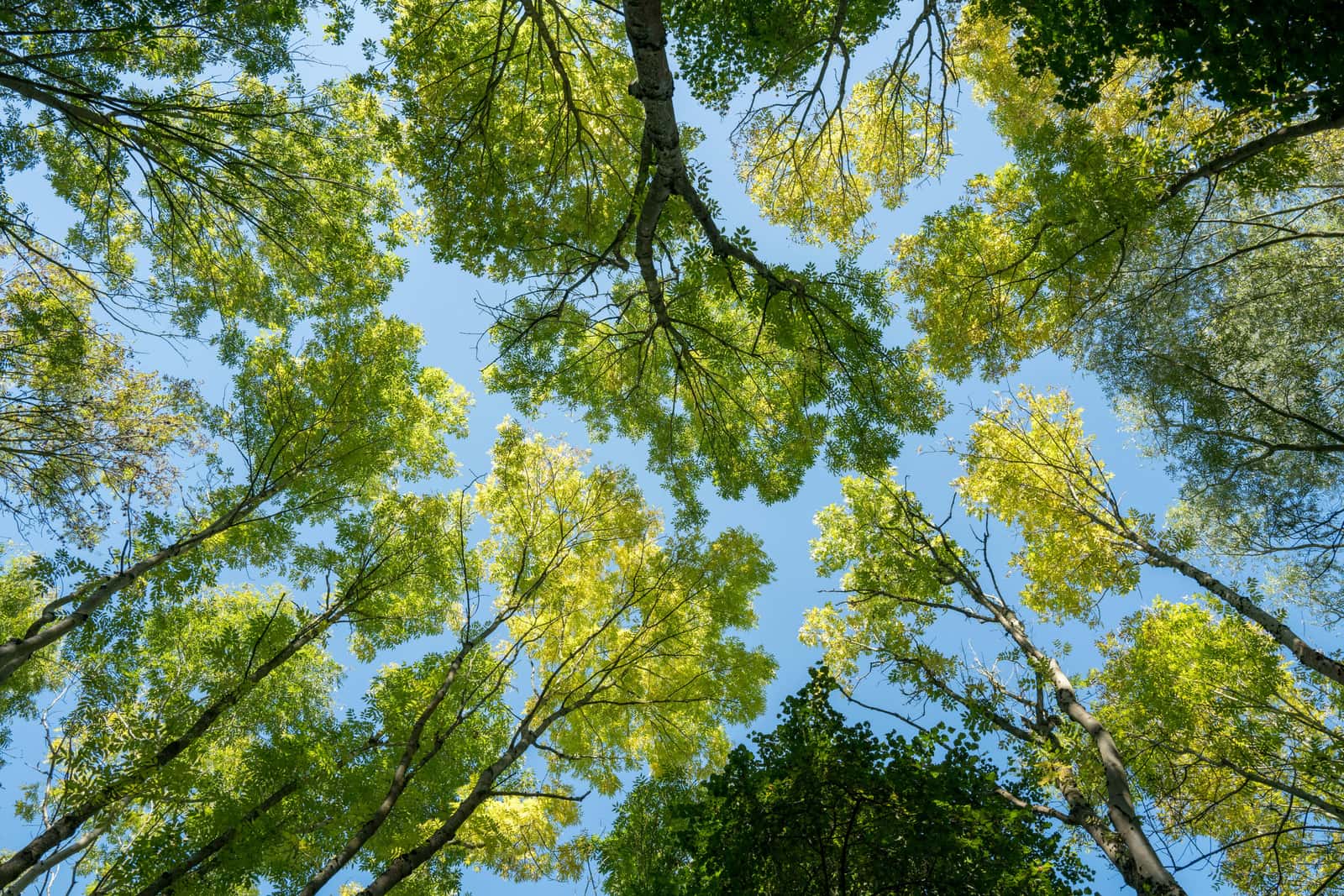
Leaves: why a winter scan can fool you
Maples, oaks, poplars and other leafy trees block far less sky in January than in July. Starlink lists this among the most common new obstructions: “New branches or leaves, especially in the spring, when trees fill in and are more likely to block the field of view.” If you check your yard between late fall and early spring, you’re seeing the best case.
- Measure to the tips of the bare branches, not to the gaps between them. In summer that whole outline is solid.
- Allow for growth. A tree that sits right at your limit today will be over it in a few years.
- Evergreens are honest. Pines, firs, spruces and cedars block the same sky in every season, so a winter scan of them is a fair scan.
Do tall pines, firs and cedars block Starlink all year?
Yes. Evergreens keep their needles, so they block the same patch of sky in January as in July, and a winter scan of them is a fair scan. Starlink’s support pages (checked Nov 3, 2026) say a single branch can be enough to interrupt service, so treat needles as solid. Under tall conifers on several sides, the fixes are a spot farther out, a cleared opening or a much higher mount.
The hardest yards in the US are under tall conifers: Douglas firs and western red cedars in the Pacific Northwest, loblolly pines across the Southeast, lodgepole stands in the Mountain West. They don’t lose their needles, and they’re often far taller than a house.
Here’s what that means in numbers. A 120 ft fir 60 ft from a dish on a 30 ft pole rises about 56°. To bring it under 35°, the dish would need to sit about 78 ft up. That isn’t a pole job. Under tall evergreens on several sides, the fixes that work are a spot farther out (a field, a driveway gap, the far side of the lot) or a cleared opening. Sometimes the answer is that the house can’t get a reliable connection until something changes.
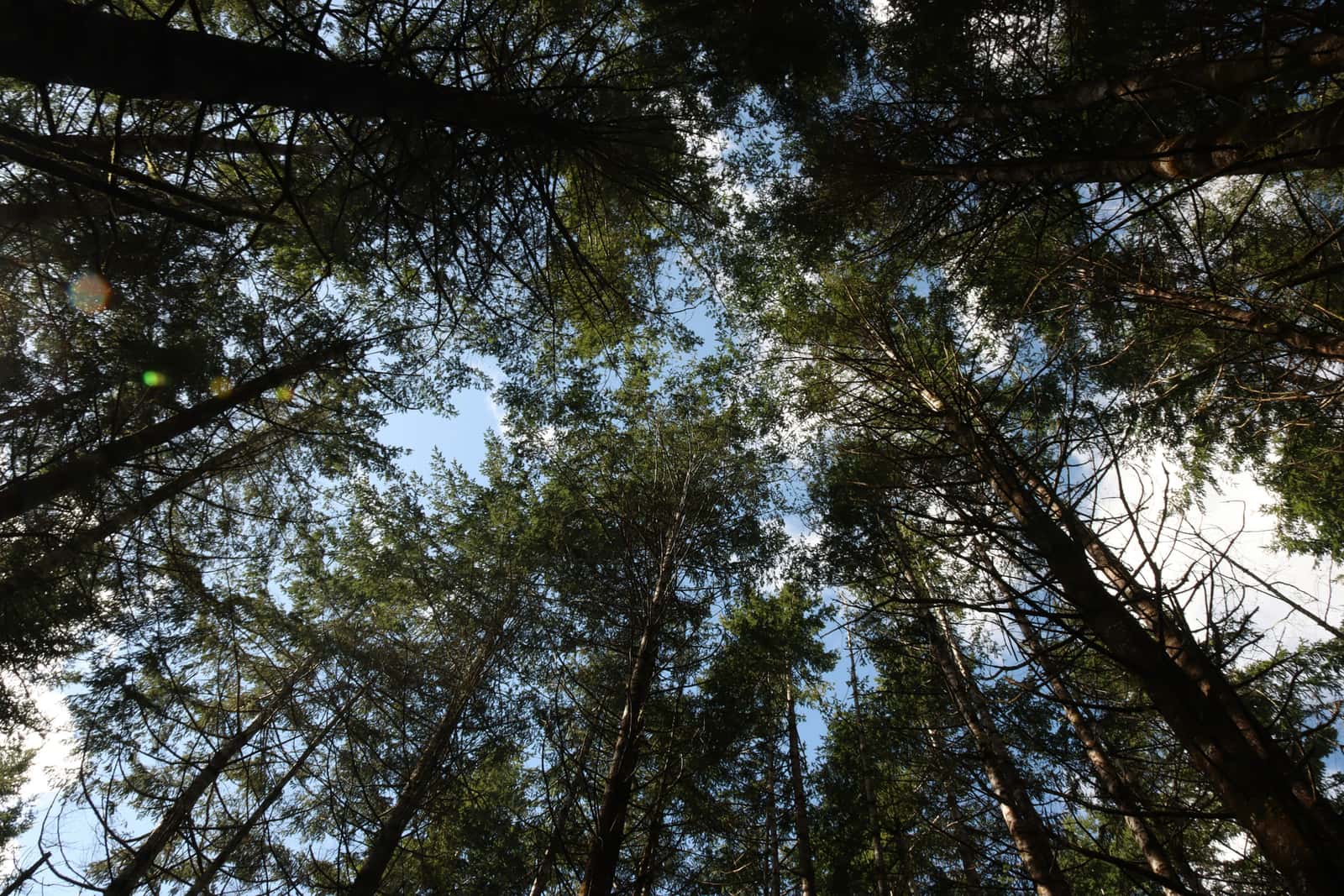
Measure your trees in 10 minutes
You don’t need a tape measure or the trees’ heights. You measure the angle directly, from the spot where the dish would go.
Step 1: Stand where the dish would go
For a roof install, get close to roof height: hold the phone out of an upstairs window opened wide, feet on the floor, or use a ladder a helper holds. For a yard install, stand on the spot.Step 2: Find the tallest tree and measure it with your fist
Hold your arm straight out, fist closed, bottom of the fist on the horizon. Stack fists up to the treetop. Each fist is about 10°.Step 3: Turn slowly all the way around
Note every tree that rises over 2 fists (20°) and every one over 3.5 fists (35°). Don’t skip any side.Step 4: Write down what you found
For each tall tree: which side, how many fists, and whether it’s leafy or evergreen. If you’re measuring in winter, measure to the tips of the bare branches.Step 5: Confirm with the Starlink app
Scan the same spot at the same height with the app’s obstruction tool. If the fist count and the scan disagree, trust the scan.
Have heights and distances instead?
Enter the tree height, the distance and the dish height into the tree and sky angle calculator. It gives the angle and the dish height you’d need to clear it. Then scan the spot with the app: how to run the app check.
Trim, raise or move? The three fixes
Starlink’s own fix list for an obstructed dish runs in this order:
- Relocate your Starlink to a clear spot. Unplug it and reboot it when you move it.
- If there is no other installation location, clear the obstruction, such as removing a branch, or raise the Starlink above the obstruction with a Starlink mount. Extended cables are available in the Starlink shop. You can also use a third-party tower or pole.
- If you cannot safely install the Starlink or clear the obstruction, do not proceed. Seek professional assistance. See the Terms of Service.
The same three choices work before you buy. Each one lowers the angle of whatever blocks the dish; which one wins depends on your yard.
| Fix | Works best when | Watch out for |
|---|---|---|
| Move the dish | There’s a clearer spot within cable reach: the other side of the roof, a garage, an open part of the yard. | The cable in the box is about 49.2 ft. Starlink sells a longer 45 m (147 ft) cable and advises against splicing or joining cables. |
| Raise the dish | The trees are close and not much taller than the house. Height helps most with near trees. | Starlink says its installers can’t do pole mounts, and it publishes no minimum height. Check HOA or town height rules. Pole mounts. |
| Clear the tree or limb | One tree or one limb does most of the blocking and you can legally remove it. | Trees regrow. Work near power lines is for the utility or a pro. Some towns and HOAs need a permit to remove trees. |
Tree work and ladders are where people get hurt
Starlink’s terms say that if you can’t install safely, don’t, and get professional help. The same goes for cutting limbs: hire a licensed, insured tree service for anything above head height or near wires.
Can you mount the dish in a tree?
Lots of people search for a “Starlink tree mount.” Starlink doesn’t publish any guidance for mounting a dish in a tree; its fix steps name its own mounts, third-party towers and poles. Third-party mounts are allowed, but Starlink says it can’t vouch for their performance.
Our reading of why a tree is a poor mount: trunks sway in wind and keep growing, and the app flags the dish as “Misaligned” once it’s 5° or more off. You’d also be climbing to fix it. A steel pole set in the ground beside the trees reaches the same height and stays where you put it.
Trees across the US: what to expect
| Region | Typical trees | What it means for the dish |
|---|---|---|
| Pacific Northwest (WA, OR, northern CA) | Douglas fir, western red cedar, hemlock | Very tall evergreens all year. Distance and clearings matter more than poles. |
| Southeast (GA, the Carolinas, AL, FL, east TX) | Loblolly and longleaf pine, live oak | Tall pines with high crowns; live oaks keep their leaves. A winter scan is close to the summer one. |
| Northeast and Midwest | Maple, oak, ash, poplar | Bare in winter, full in summer. Measure to the branch tips or scan again after leaf-out. |
| Appalachia (WV, KY, TN, western NC) | Hardwoods on steep slopes | Trees on top of ridges add to the ridge itself. Valleys and hollows. |
| Mountain West (CO, MT, ID, WY) | Lodgepole pine, spruce, aspen | Dense evergreen stands; aspens leaf out. Canyons add terrain on top. |
Don’t order yet if…
- tall evergreens rise over 3.5 fists on two or more sides of every spot you could use, and there’s no clearing within cable reach
- you’re checking in winter and the bare crowns of leafy trees already reach 2 fists or more
- the fix needs tree work near power lines or on a neighbor’s land that you can’t arrange
- the only fix is a pole or mast taller than you can install safely, and you haven’t lined up help
Questions this page answers
Will Starlink work if I have trees around my house?
Often, yes. Starlink says the dish does best with open sky and can often get by with part of it. Trees that stay under about 20° above the horizon from the dish (about 2 fists at arm’s length) are out of the way. Trees that rise above about 35° on several sides will cause regular dropouts, and you’d need a higher or clearer spot.
Does Starlink work through trees or leaves?
Treat leaves, needles and branches as solid. Starlink doesn’t publish a figure for signal through foliage, and its own example of an obstruction is a single tree branch. The dish works around trees by using satellites in the open parts of the sky, not by seeing through them.
How far from trees does Starlink need to be?
There’s no single distance, because tall trees need more room than short ones. Starlink publishes no distance-from-trees rule for home installs. What counts is the angle: a 60 ft tree 150 ft away still rises about 21° above a dish on the ground. Put your own numbers into the sky angle calculator.
Should I cut down trees to get Starlink?
Only after the app scan shows a specific tree is the problem, and after you’ve looked for a clearer spot or a higher mount. Starlink’s own order is: move the dish first, then clear the obstruction or raise the dish. Often one limb is enough, not the whole tree.
Will Starlink work in the woods or a heavily wooded lot?
Only if you can get the dish into open sky: a clearing, a field, a gap over the driveway, or a mount above the canopy. Under continuous tall trees on every side, the answer is no until something changes.
My yard scans clear in winter. Will it still work in summer?
Not necessarily. Starlink lists “new branches or leaves, especially in the spring, when trees fill in and are more likely to block the field of view” as a common new obstruction. Measure to the outline of the bare branch tips and treat that as solid.
Can I mount my Starlink dish in a tree?
Starlink doesn’t publish any guidance for tree mounts, and trees sway and grow, which can knock the dish out of alignment. A pole set beside the trees does the same job and stays put. Pole and mast mounts.
What we checked this page against
- Standard 4 X spec sheet, PDF · seen Nov 3, 2026
- Business install: choosing a location (support article) · seen Nov 3, 2026
- Aligning the dish (support article) · seen Nov 3, 2026
- Measuring the sky with your hand (EarthSky) · seen Nov 3, 2026
- Checking a spot before you install (support article) · seen Nov 3, 2026
- Fixing obstructions (support article) · seen Nov 3, 2026
- What obstructions do to service (support article) · seen Nov 3, 2026
- Standard 4 X setup guide, PDF · seen Nov 3, 2026
- Standard 4 X setup guide (support article) · seen Nov 3, 2026
- Cable length and indoor routing (support article) · seen Nov 3, 2026
- Starlink shop, public accessory prices · seen Nov 3, 2026
- Starlink installers (support article) · seen Nov 3, 2026
- Third-party mounts (support article) · seen Nov 3, 2026
- US terms of service · seen Nov 3, 2026
Each number on this page traces back to one of these entries; our fact rules explain how. If a reading has drifted, the corrections log shows how it gets fixed.